Addressable vs Conventional –
For businesses in Harrogate, choosing the right type of fire alarm system is one of the most important decisions in achieving both compliance and effective protection. One of the most common questions is whether to install a conventional system or an addressable system. While both meet fundamental fire safety requirements, they operate very differently and are suited to different types of premises.
Understanding the distinction is key to ensuring that the system installed is fit for purpose rather than just compliant.
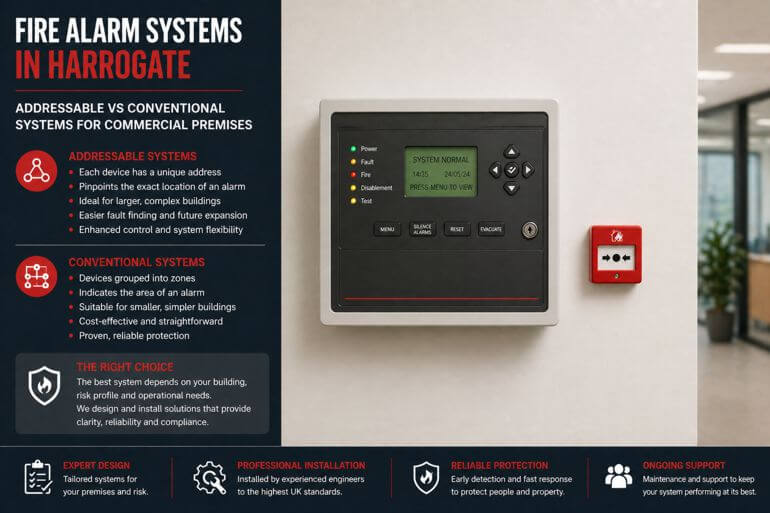
A conventional fire alarm system divides a building into zones. Each zone contains multiple devices, such as detectors and call points, all wired back to the control panel. When an alarm is triggered, the panel indicates which zone the activation has come from, but not the exact device.
In smaller Harrogate commercial premises, such as single-floor offices or compact retail units, this approach can be sufficient. It provides a straightforward and cost-effective solution where the building layout is simple and the source of an alarm can be identified quickly.
However, in larger or more complex buildings, conventional systems have limitations. When a zone contains multiple rooms or areas, identifying the exact location of an activation can take time. This can delay response and increase disruption, particularly in busy commercial environments.
Addressable fire alarm systems take a more advanced approach. Every device on the system has a unique address, allowing the control panel to identify the exact location of an alarm activation. Instead of indicating a general zone, the system can pinpoint the specific detector or call point that has been triggered.
For Harrogate businesses operating in larger premises, multi-floor buildings or sites with complex layouts, this level of detail provides a significant advantage. It enables faster investigation, more targeted response and improved overall control.
Addressable systems also offer greater flexibility. They can be programmed to respond differently depending on the location and type of activation. For example, alerts can be prioritised, delays applied where appropriate or integrations triggered with other systems.
This makes addressable systems particularly suitable for commercial environments with varying risk levels, such as hotels, offices, healthcare facilities and larger retail spaces.
Another key benefit is scalability. As businesses grow or premises are reconfigured, addressable systems can be expanded and adapted more easily than conventional systems. In Harrogate, where many businesses evolve over time, this flexibility is a major advantage.
Maintenance and fault finding are also more efficient with addressable systems. Because each device is individually monitored, faults can be identified and located quickly. This reduces downtime and ensures that the system remains fully operational.
Despite these advantages, conventional systems still have a place. For smaller premises with simple layouts and lower complexity, they can provide a reliable and cost-effective solution. The key is ensuring that the system matches the building, rather than defaulting to one option.
Compliance remains essential regardless of system type. Both conventional and addressable systems must be designed, installed and maintained in line with relevant standards. In Harrogate commercial premises, this ensures that fire safety requirements are met and systems perform as expected.
Staff awareness is also important. Regardless of system type, employees should understand how the system operates and how to respond to alarms. Clear procedures ensure that alarms are taken seriously and acted upon correctly.
Integration with other fire safety measures should also be considered. Fire alarms work alongside evacuation plans, emergency lighting and other systems to provide a complete approach to fire safety.
For businesses in Harrogate, the choice between addressable and conventional fire alarm systems comes down to building complexity, operational requirements and long-term flexibility. By taking a considered approach, businesses can ensure that their fire alarm system provides both compliance and practical, effective protection.
Ultimately, the right system is the one that delivers clarity, reliability and confidence — ensuring that when an alarm is triggered, the response is fast, accurate and effective.