False fire alarms are often dismissed as little more than an inconvenience. In reality, repeated unwanted fire alarm activations can create significant operational, financial and safety issues for businesses in Harrogate. Over time, persistent false alarms can reduce confidence in the system, disrupt operations and even affect emergency response priorities.
Modern commercial fire alarm systems should be designed not only to detect fire quickly, but also to minimise unnecessary activations. Achieving this balance requires careful system design, correct detector selection and ongoing maintenance.
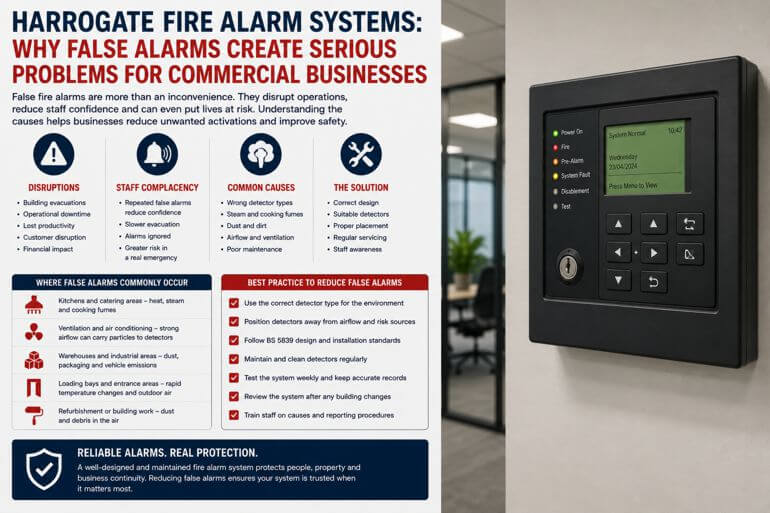
False Alarms Disrupt Business Operations
Every false alarm has consequences.
In Harrogate commercial premises, activations can lead to:
- full building evacuations
- operational downtime
- interrupted meetings
- halted production
- customer disruption
- and lost productivity
For hospitality, retail and office environments, repeated false alarms can quickly become costly.
Staff Can Become Complacent
One of the biggest long-term risks is reduced staff response.
If employees experience frequent false alarms, they may begin to:
- evacuate more slowly
- ignore alarm activations
- assume alarms are non-genuine
- or fail to follow procedures properly
This complacency becomes dangerous during a real emergency where immediate evacuation is critical.
Incorrect Detector Types Are a Common Cause
Many false alarms occur because the wrong detector type has been installed in the wrong environment.
Examples include:
- smoke detectors too close to kitchens
- detectors installed near steam sources
- devices positioned close to extraction systems
- or detectors exposed to dust and airborne particles
Correct detector selection is one of the most important factors in reducing unwanted activations.
Airflow and Ventilation Affect Detection
Commercial buildings often contain:
- air conditioning systems
- extraction fans
- heating systems
- and ventilation ducting
These airflow patterns can carry:
- steam
- dust
- aerosols
- or cooking fumes
toward detectors unexpectedly.
In Harrogate offices, restaurants and mixed-use premises, this issue is particularly common.
Building Changes Can Increase False Activations
Commercial premises evolve over time.
Changes such as:
- new partition walls
- layout alterations
- different room usage
- additional machinery
- or increased occupancy
can all affect how the fire alarm system performs.
Systems should always be reviewed following significant building changes.
Poor Maintenance Increases Problems
Dirty or poorly maintained detectors are far more likely to false alarm.
Common maintenance issues include:
- dust contamination
- ageing detectors
- damaged devices
- battery problems
- and calibration drift
Routine servicing helps identify these issues before they create disruption.
Detector Placement Matters
Positioning plays a major role in system reliability.
Detectors should avoid:
- direct airflow
- kitchens and food prep steam
- dusty warehouse areas
- loading bays
- and changing environmental conditions
Correct spacing and placement in accordance with BS 5839 significantly improve performance.
Different Premises Require Different Strategies
Not every commercial building should use identical detection methods.
For example:
- offices may rely heavily on optical smoke detection
- kitchens require heat detection
- warehouses may need beam detection
- server rooms may require aspirating systems
The system should reflect the actual operational risks within the premises.
False Alarms Can Affect Emergency Services
Repeated unnecessary activations can also affect emergency response procedures.
Persistent false alarms may lead to:
- reduced urgency perceptions
- investigation charges
- or increased scrutiny of fire safety management
Businesses should take repeated activations seriously rather than accepting them as normal.
Staff Training Helps Reduce Unwanted Activations
Employees should understand:
- how the system operates
- activities that may trigger detectors
- reporting procedures
- and evacuation responsibilities
Simple awareness training often helps reduce avoidable activations.
Weekly Testing and Servicing Remain Essential
Businesses in Harrogate should ensure:
- weekly fire alarm testing
- regular servicing
- detector cleaning
- and maintenance records
are all carried out consistently.
These processes help identify reliability issues before they escalate.
Fire Alarm Systems Should Be Reliable and Trusted
A fire alarm system should inspire confidence, not frustration.
For businesses in Harrogate, reducing false alarms improves:
- operational continuity
- evacuation behaviour
- staff confidence
- and overall fire safety effectiveness
Correct design, maintenance and detector selection ensure that commercial fire alarm systems remain both compliant and dependable when they are needed most.
Frequently Asked Questions
What is the most common cause of false fire alarms?
Incorrect detector placement and unsuitable detector types are among the most common causes.
Can dust trigger commercial fire alarms?
Yes. Dust contamination can affect detector sensitivity and lead to unwanted activations.
Should fire alarm systems be reviewed after office changes?
Absolutely. Layout and operational changes can affect detector performance and system effectiveness.